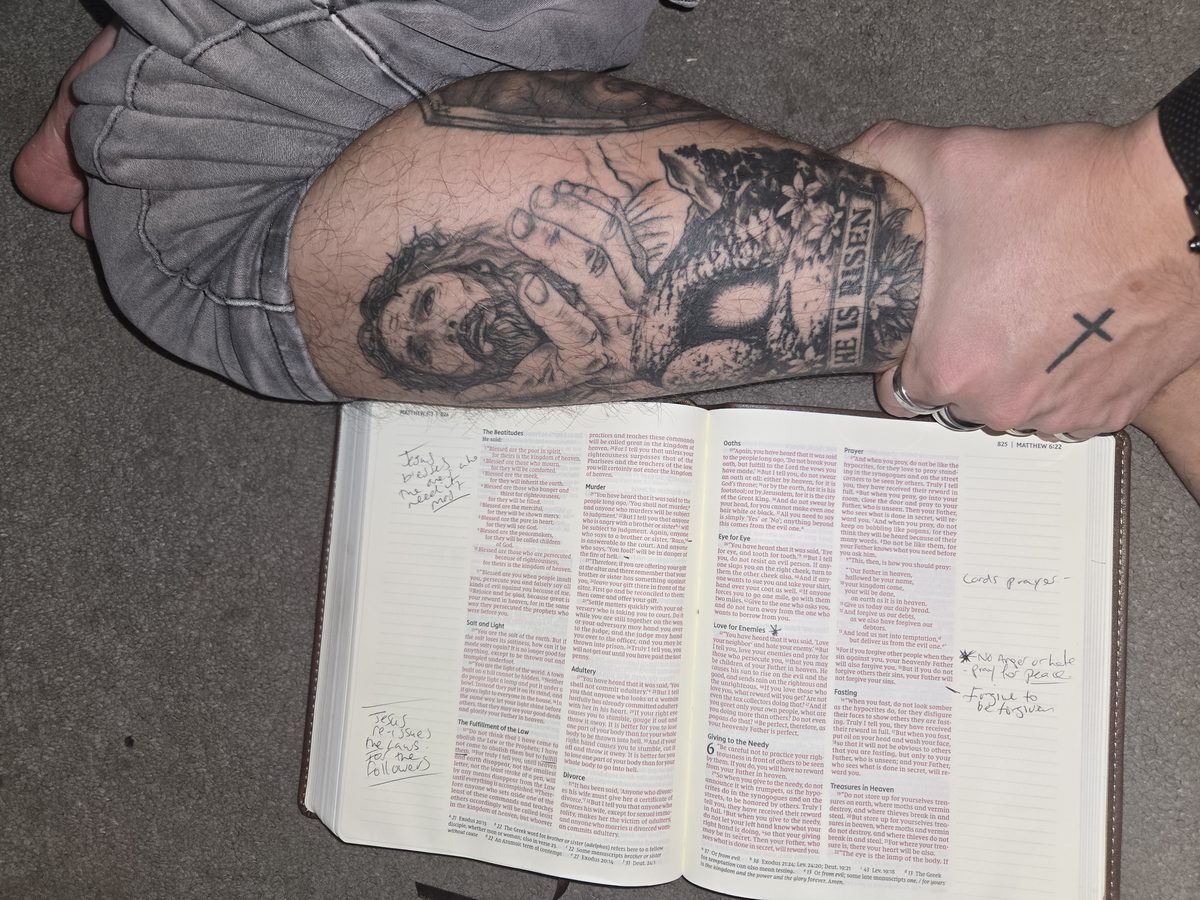
I feel a little guilty about fasting. More precisely, about not fasting.
It is an odd thing to feel guilty about, given the rest of my week. I read scripture and pray every day. I talk to God. I watch documentaries and shows about faith. I listen to Christian rock every day. I go to church twice a week. I have faith-centred tattoos, faith-centred clothes and faith on the walls at home. I like to feel dressed in Christ.
And still, near the back of all that, there is the one thing I do not do.
So I went looking, with the question as plain as I could make it: as a Christian, should I be fasting? Most of what I found at first was the overview you would expect, the types of fast and the reasons people do it. When I narrowed it down to the guilt, the answers changed shape.
What I found said that my standing with God rests on grace and not on a checklist. That fasting is a tool and not a test. That the New Testament assumes the practice but never commands it, and that fasting out of guilt or duty runs against what Jesus actually taught about it.
The texts bear that out as far as they go. In the Sermon on the Mount, Jesus says when you fast, not if, and then spends the rest of the passage on doing it privately, with a washed face, so that nobody but the Father notices. When He is asked why His disciples do not fast, He says they will, once the bridegroom has been taken from them. And in Acts, the early church fasts at the moments that matter: when Barnabas and Saul are sent out, and when elders are appointed.
So it is expected, and it is not ordered. Which is exactly the kind of answer that leaves the guilt with nowhere obvious to go.
Looking back over my own list, I noticed something. Every item on it adds. Reading, prayer, music, shows, the clothes, the ink, the walls. All of it is me putting more of my faith into my day. Fasting is the only thing on the list that takes something away, and I suspect that is why it is the one that nags.
One suggestion I came across was to start small, and not necessarily with food. One day without the Christian rock and the documentaries, replaced with silence. I noticed that the first fast on offer would remove the very things I had just listed as evidence that I take this seriously.
The last thing I looked into was what fasting actually does for prayer.
The main answer was that it does not change God’s mind. It changes the person praying. Hunger becomes a prompt to turn back. The noise drops, so there is more room to listen. The body is brought into line with the weight of what is being asked for. Somebody praying for a sick family member is not only saying the words, they are carrying them.
Most of that I can follow. One part I want to hold more carefully.
The last time I wrote here, it was about whether the asking does anything at all. The tidy version, that fasting changes me and not God, is one account the tradition gives. It is not the only one. In Ezra, the people fast and petition God before a dangerous journey, and the text says plainly that He answered. In Jonah, a whole city fasts and God relents. The Bible does not treat fasting purely as self-improvement. It treats it as asking, with the body as well as the mouth.
And then there is Isaiah, where God says the fast He has chosen is loosing the chains of injustice and sharing food with the hungry. That turns the whole thing outward. Going without is not the point. What the going without is for, and who it is for, is the point.
I have not decided whether I will fast. I am still trying to work out whether I should, and the guilt has not fully gone. What has changed is the question. It started as whether I was falling short. It has become what, if anything, I would be making room for.
If you fast, I would like to know what it did for you, and what it did not. If you do not, and you carry the same small guilt about it, you are not the only one sitting in church with it.