This term, my Exploring Christianity course has moved on to the Old Testament. Some of it is hard going for me, and it is not the long genealogies or the building measurements.
It is the violence. There are passages where a prophet commands killing, and passages where the killing is put down to God Himself. I have faith in a God of love and mercy, and then I turn a page and find this. The question is what to do with it. I do not want to explain it away, and I do not want it to become the truest picture I have of who God is.
I spent some time researching it, and the idea that came out of it was simple to state. Read the whole Bible with Jesus as the lens.
The New Testament says this more or less directly. The letter to the Hebrews opens: In the past God spoke to our ancestors through the prophets at many times and in various ways, but in these last days he has spoken to us by his Son. Many times, various ways, and then the Son. The prophets were real people, speaking to real people at a particular point in history, often in a culture fighting for its survival. Paul says we know in part and we prophesy in part. He includes himself in that.
So the picture is of God reaching out through human limits, patiently, over centuries, leading people forward. And then, in Jesus, showing Himself fully. If you want to know what God is like, you look at Jesus. Where something earlier seems to point another way, Jesus gets the final word.
What convinced me this was more than a convenient idea is that Jesus reads His own scriptures this way.
In the Sermon on the Mount, He takes one teaching after another and says, in effect, you have heard it said, but I tell you. An eye for an eye becomes turning the other cheek. Love your neighbour becomes love your enemies. Elsewhere, twice, He sends His critics back to the prophet Hosea, where God says He wants mercy and not sacrifice.
The easy version of this is that Jesus threw out the old law. The text will not let me say that. In the same sermon He says He has not come to abolish the law or the prophets, but to fulfil them. He is not tearing the Old Testament up. He is showing what it was reaching for all along.
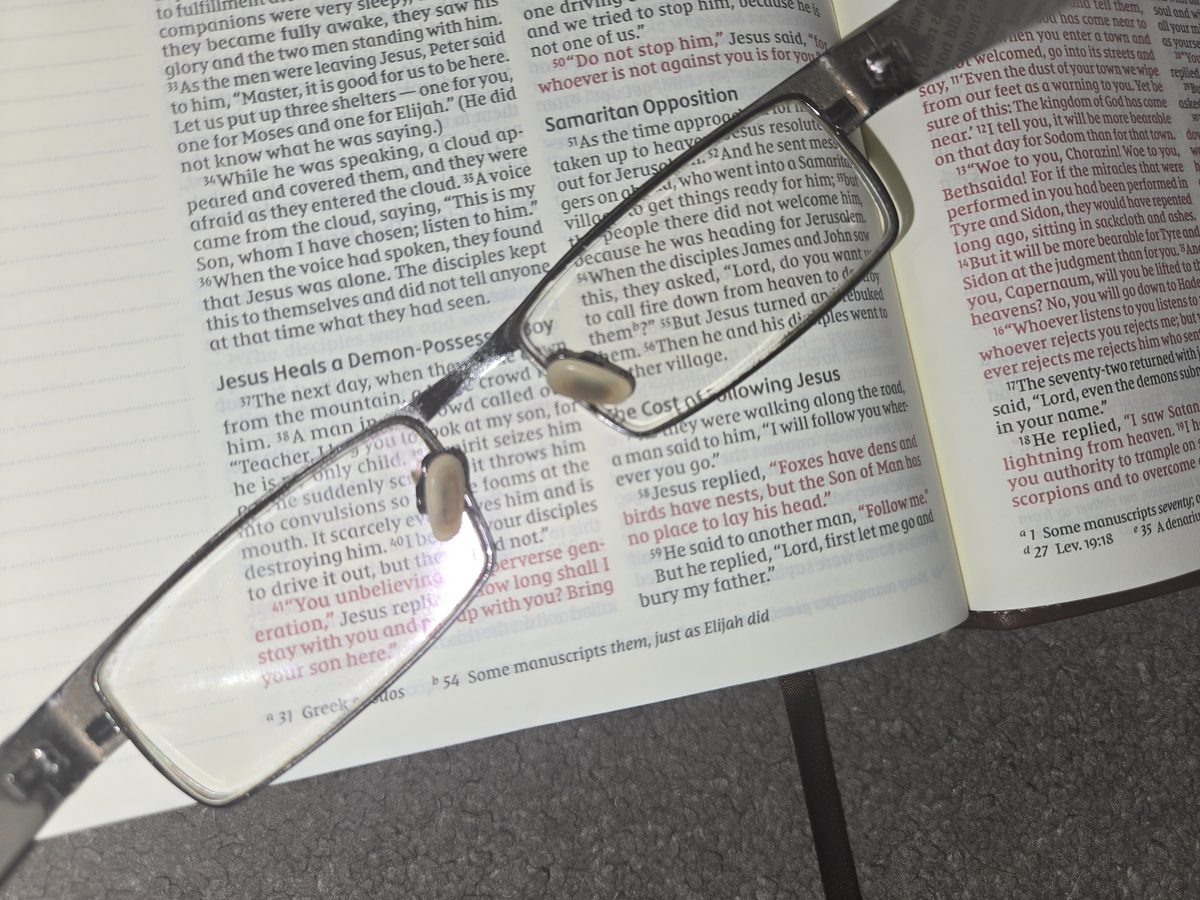
The passage that stays with me most is in Luke. Jesus is heading for Jerusalem and sends messengers ahead into a Samaritan village, and the village will not receive Him. James and John ask whether He wants them to call down fire from heaven and destroy them. They have a precedent. Elijah did exactly that, in the second book of Kings.
Jesus turns and rebukes them.
Some early manuscripts add what He said: that they do not know what spirit they belong to, and that the Son of Man came not to destroy lives but to save them. Most modern translations put those words in a footnote, because the oldest copies do not have them. But the rebuke is there in every version. Two of His closest friends reach for an Old Testament story of fire and death, and Jesus says no.
That is the lens working in real time. Same God, same scriptures, and a different reading, from the one person with the authority to give it.
Where does that leave me with the hard passages? They are still there. I will be reading some of them this term, and I am not going to pretend they have become easy. But I no longer feel I have to accept ancient violence as the clearest view of God’s will. I can hold those passages as part of a long story of people coming to know God, sometimes seeing clearly and sometimes not, and read them in the light of where the story ends up.
I know not every Christian reads the Old Testament this way. Some hold the whole of it together without any sense of correction, and they have serious reasons for doing so. This is the reading that makes sense to me at this point in my journey, and it is one the church has been arguing over for a long time.
If you have found a way through these passages that works for you, I would like to hear it. And if you are stuck on them, you are in good company. So were James and John.