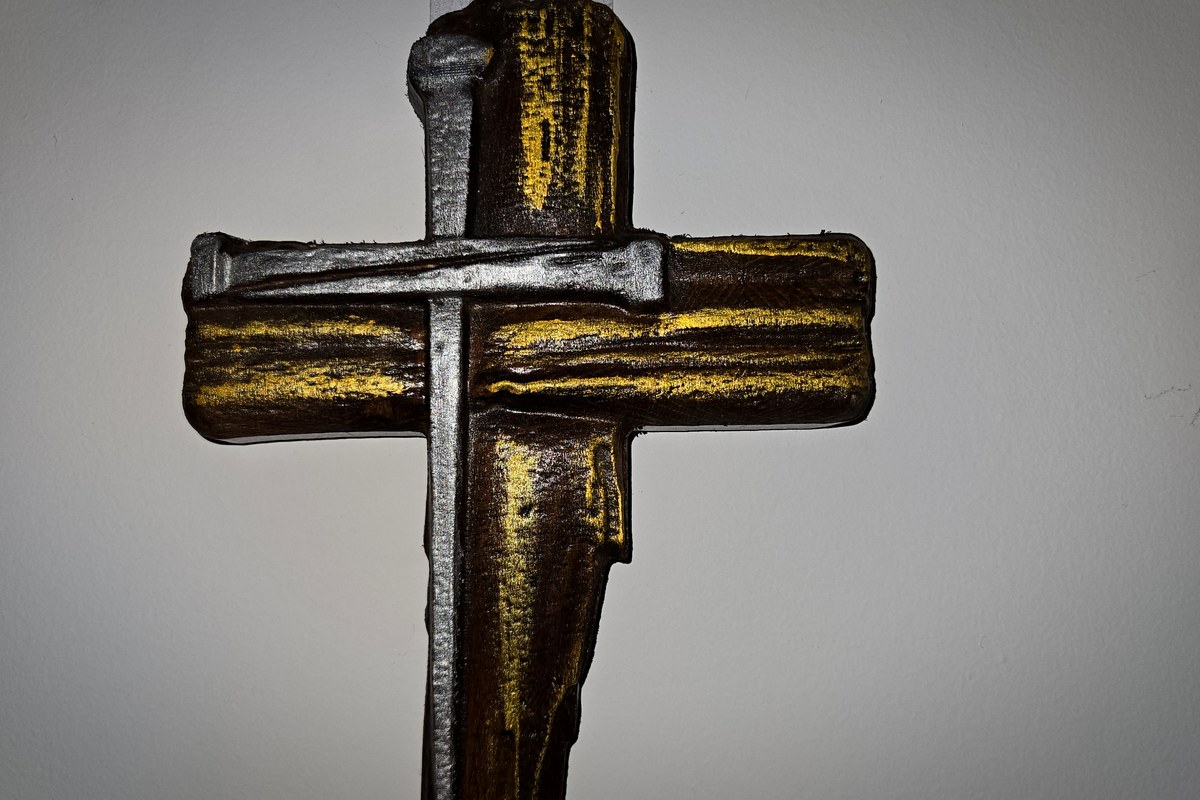
The question comes up more than any other, and it is a good one. If He was who He said He was, why did He not defend Himself? A man with that kind of power, arrested in a garden at night on charges everyone involved knew were manufactured, and He does nothing. He does not argue. He barely speaks. He lets it happen. People raise this as an objection, but I notice they usually raise it as a puzzle, which is different. They have read the story and found something in it that does not behave the way a story like that should behave.
The short answer is love. I first met it put that way in a film, where, as I remember it, the reply to that exact question was that it is very simple, and the answer is love. I am going from memory rather than from the script, so take the wording as mine. I understand why it is said like that, and it is the right answer. But given on its own and given first it tends to close the conversation rather than open it. The person asking has brought you something they found strange, and a single abstract noun in reply tells them the strangeness was not worth taking seriously. It also confirms the thing they already half suspect, which is that under the history there is nothing but sentiment. So I want to get to love the long way round, through the text, because the text asks the question itself and does not leave it hanging.
Start in the garden. Peter draws a sword and takes a man’s ear off, and John gives us the detail that the man was called Malchus, which is the kind of detail people do not usually invent. Peter is told to put the weapon away. In Matthew the reason given is that He could ask His Father and have more than twelve legions of angels standing there at once. In John He asks whether He should not drink the cup His Father has given Him. Luke has Him reach out and heal the injured man, which means the last recorded act of His freedom is to repair the damage done by someone defending Him.
Read that as a scene and notice what it is doing. It goes out of its way to establish that the power is available and is being declined. The Gospels could simply have shown a man overwhelmed. Instead they stop the action to have Him name the army He is not going to call.
That is not an isolated moment either. Earlier He says that nobody takes His life from Him, that He lays it down of His own accord, and that the authority to lay it down and to take it up again is His. When a crowd tries to make Him king by force, He removes Himself. In front of Pilate He mostly says nothing at all, and the governor is recorded as being astonished by the silence, which is a strange thing for a Christian writer to include if the aim were to present a commanding figure.
Then comes the part that decides the question. At the cross the crowd tells Him exactly what would satisfy them. Come down, and we will believe. There is the offer, stated plainly by His opponents. One demonstration and the argument ends for ever, in front of witnesses, in the capital, at Passover, with the whole city watching.
He does not take it.
This is where love stops being a sentiment and starts being an argument, because you have to ask what sort of belief that demonstration would have produced. Belief extracted by a display of force is agreement with a fact. Anyone would have agreed. Nobody watching a man step down off a cross has any choice in the matter. But agreement compelled by overwhelming power is not what the whole thing had been asking for from the beginning. In an earlier article I used the image of a machine built to say the words I love you, which says them perfectly every time and never once means them, because devotion that cannot be withheld is not devotion. Coming down from the cross would have manufactured exactly that. It would have won the argument and lost the point.
So the restraint in the garden and the restraint at the cross are the same restraint, and it is the same principle that runs through everything else He is recorded as saying about the human heart. God does not compel. He asks. He made creatures capable of refusing Him and then, at the one moment in history when overruling that would have been justified and effective and entirely within His power, He did not overrule it. That is what love means in this context. Not warmth. A deliberate refusal to force an outcome He could have forced.
Now the honest part, because these articles are no use to anyone if they only run one way.
A sceptical reader will say that this is precisely what you would expect a movement to produce after the fact. Their leader was executed as a criminal, which was a catastrophe and an embarrassment, and the explanation that it was voluntary all along is exactly the story you would construct to survive it. It is worth noticing too that the twelve legions line is in Matthew and nowhere else, and the healing of the ear is in Luke and nowhere else, which is the sort of distribution that makes historians cautious. Those are fair points and I am not going to pretend otherwise.
What I would say against them is this. Paul, writing early, describes preaching a crucified messiah as a scandal to one audience and nonsense to the other, which tells you the first Christians knew perfectly well they were selling something nobody wanted to buy. A movement free to invent its founder’s death would not have invented that one. And whatever you make of the individual scenes, the explanation they reached for is consistent from the earliest material we have. Not that He was overpowered. That He gave Himself, and that this was the point rather than the disaster.
Which brings it back round to where it started. The answer really is love. It is just that love, here, is not a feeling anybody had. It is a decision not to use power that was there to be used, taken by someone who was told to His face that using it would settle the argument, and who understood that an argument settled that way would have been worth nothing.
That is why He did not defend Himself. He was not protecting His reputation, or His life, or His case. He was protecting your ability to say no to Him. Including, if you choose, today.